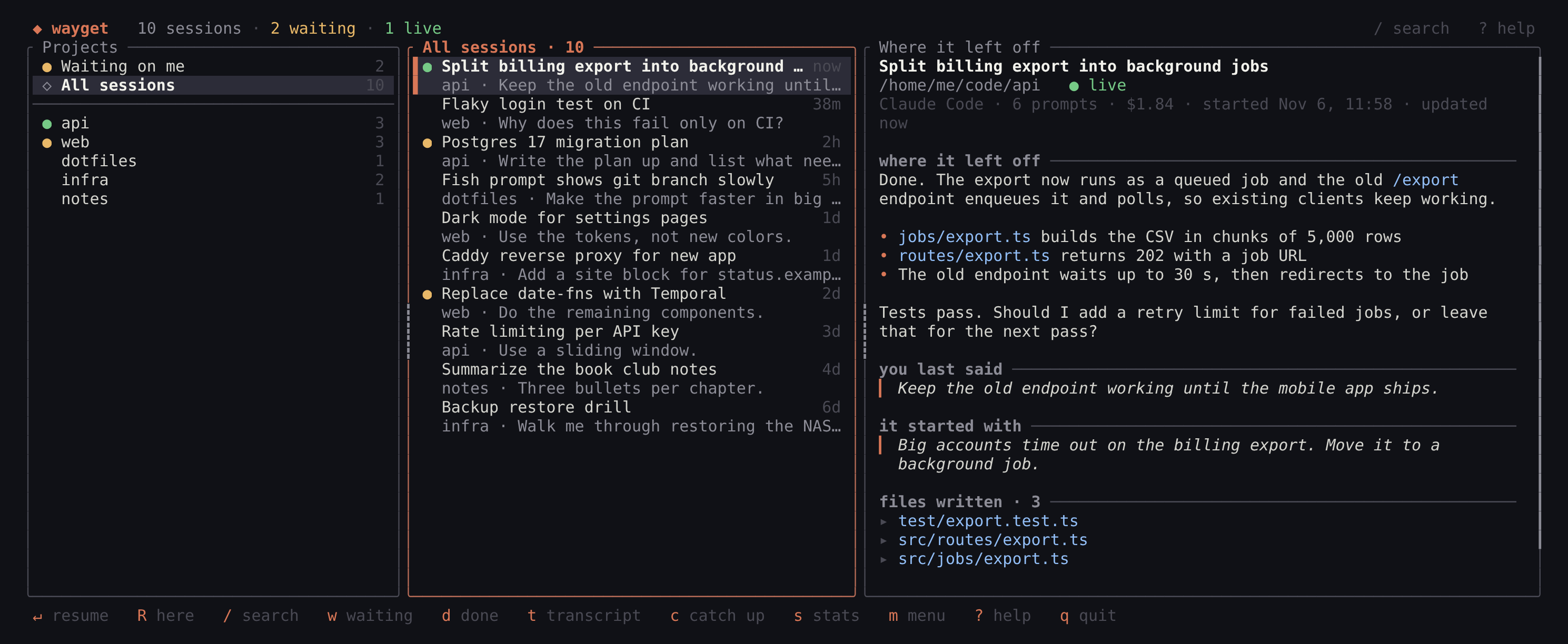
Claude Code keeps a transcript of every session in ~/.claude/projects, and pi keeps its own in ~/.pi/agent/sessions, but finding an old session again means scrolling a list of first prompts. wayget reads both, without changing them, and lays them out in three panes: projects, sessions newest first, and where the selected session left off. That last pane shows the agent’s final reply, your last prompt, the files it wrote and any artifacts it published. For a pi session with branches, it shows the branch pi would resume.
Sessions where the agent asked you something and is waiting get an amber dot until you mark them done. By default that means its last reply ends in a question. With a key for Jev, a small yes/no model, it decides instead, reading the last 1,000 bytes of the reply with anything that looks like a credential masked first. Sessions active in the last 90 seconds pulse green.
Enter resumes a session with claude --resume or pi --session in a new tab in its own folder and leaves the board open. That works inside tmux anywhere, and in Ghostty, iTerm2 and Terminal.app on macOS. In other terminals it quits and resumes in place.
It also has full-text search across prompts and replies, a folded transcript view, usage stats by week and project, mouse support with panes you can resize by dragging, and an on-demand three-line summary from Haiku. wayget --list prints a plain table for scripts.
It was called waygate-cs until version 0.6.0, when it started reading pi sessions. It runs on macOS and Linux. Install it with the shell installer from the releases page or with cargo install --git.